Your issuer's research has to stay in India.
Can your platform prove where it is?
From 3 January 2026, SEBI requires a merchant banker to keep all data and information inside India. OfferingDesk hosts pre-deal research in India, checks every investor before a page opens, and records who read what.
From Rules to Proof
The export is the record written at each open.
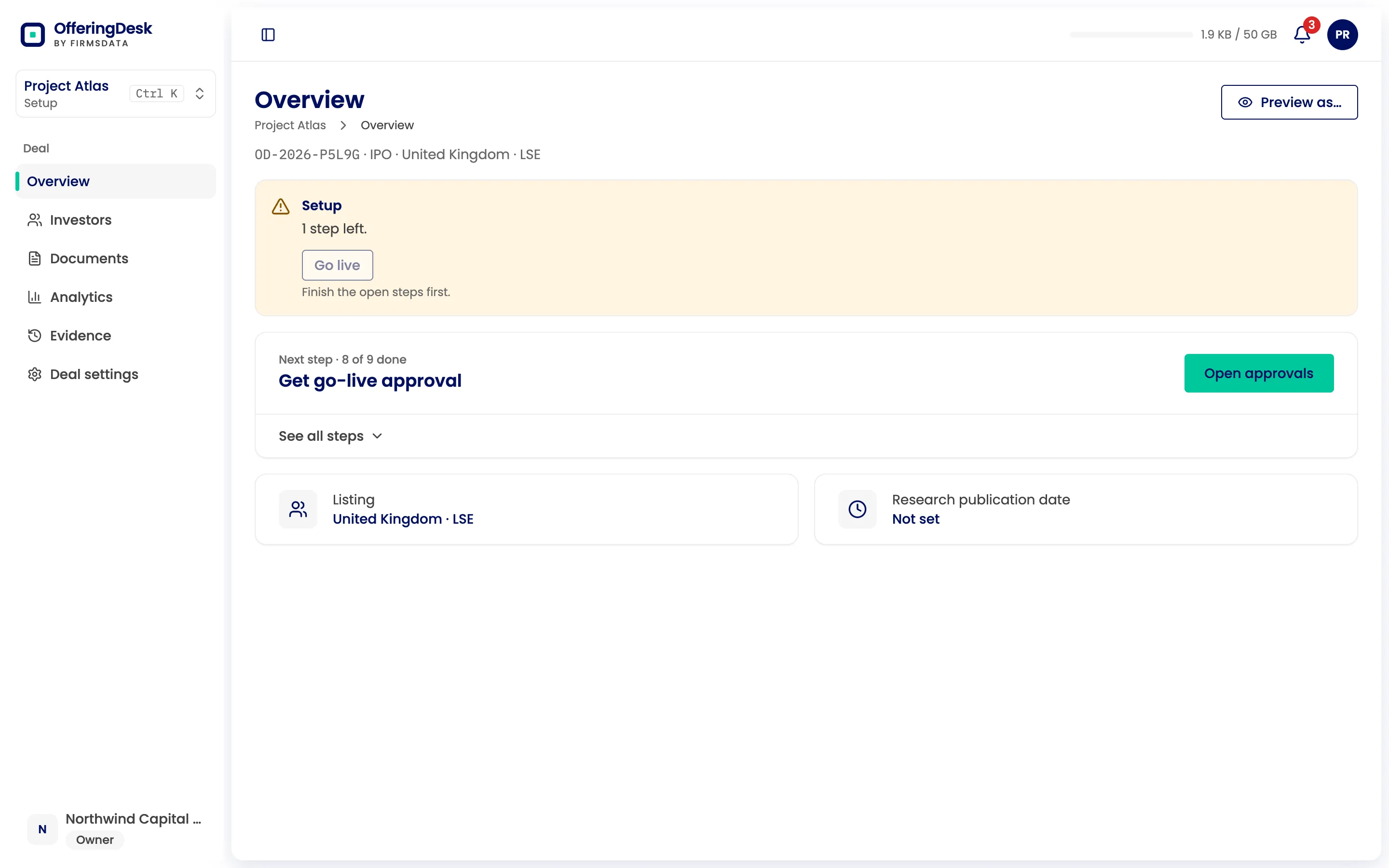
Set the access
Choose the countries the deal allows in its access settings.
Gate every reader
Five checks run in order before a single page renders: consent, country, investor category, deal stage and disclaimer.
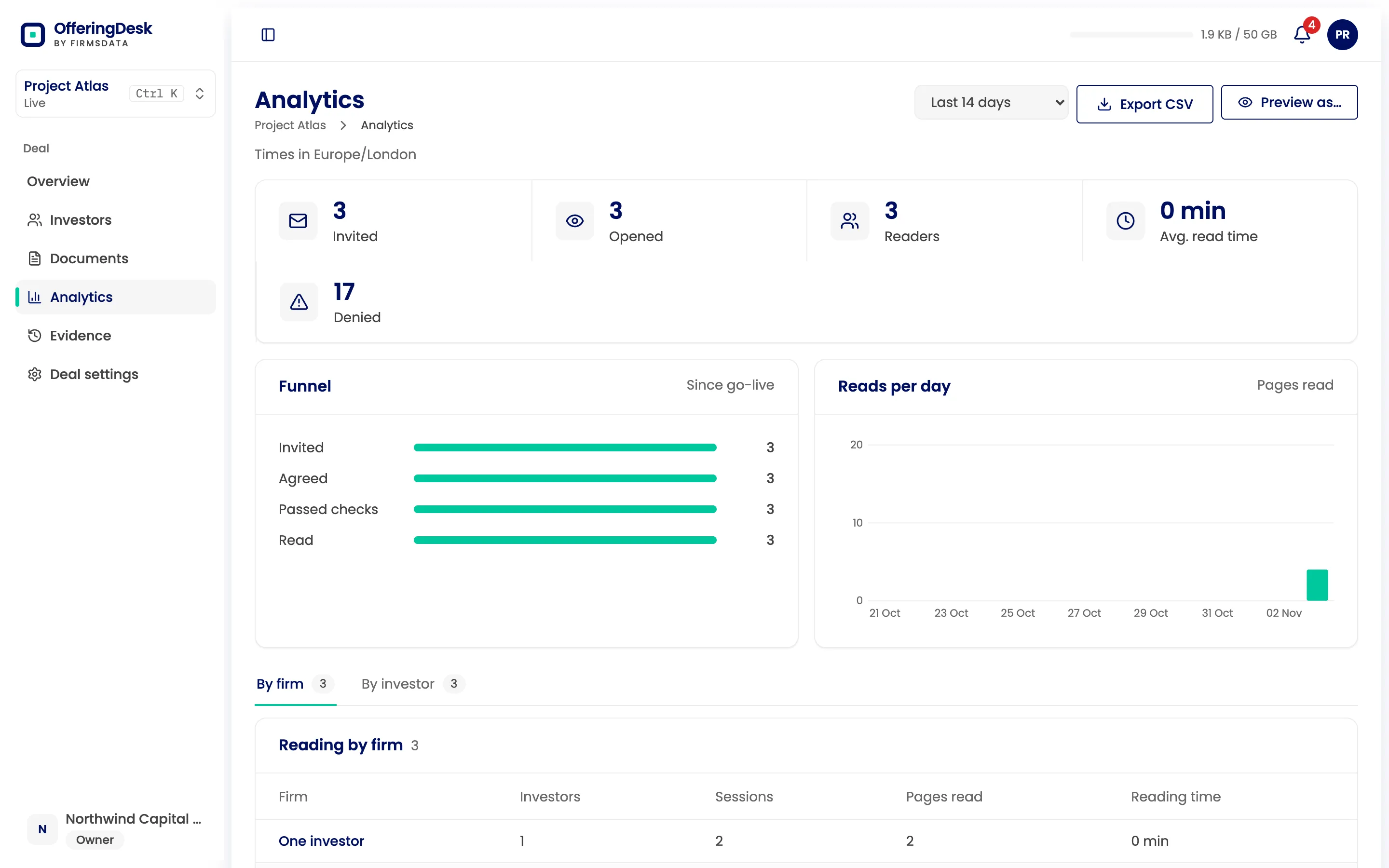
Export the proof
One file shows who read what and when, which rule allowed or refused each open, and whether anything was altered.
A Simple, Seamless Platform Experience
Where Your Research Is Hosted
Primary storage, backups, logs and the audit chain are hosted in India by default. Administrative access from outside India is a configured, audited decision. Hosting is confirmed in writing at contracting.
Duty: SEBI (Merchant Bankers) Reg. 16(2), applicable 3 Jan 2026
How Controlled Pre-Deal Research Distribution Works
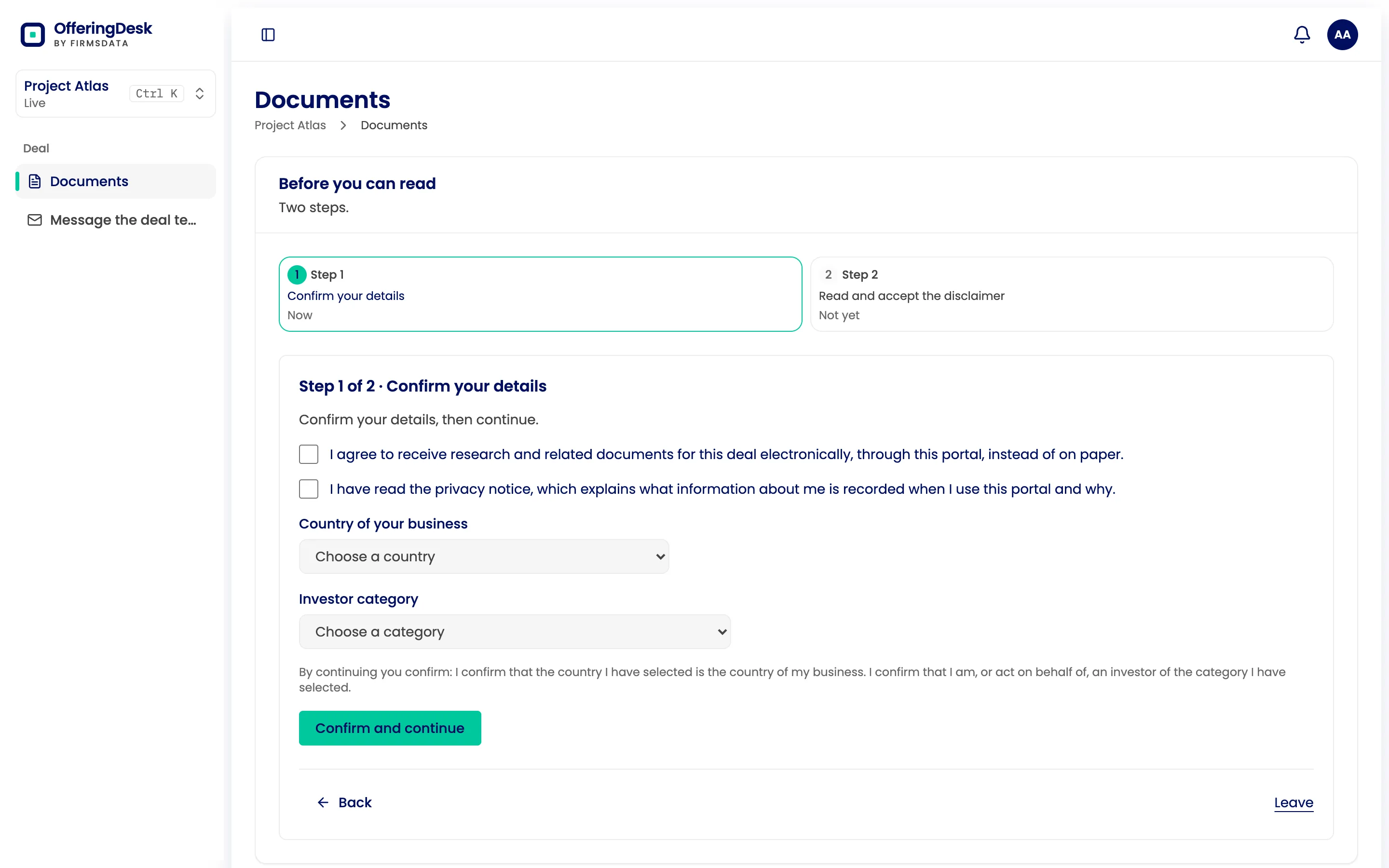
Every investor passes five ordered checks before a single page renders. Each page they see carries their name and serial number, and every open is recorded before the page is shown.
Consent
E-delivery consent, captured and versioned before anything renders.
Country
Self-certified, cross-checked against geo-IP. A lookup failure denies.
Category
QIB, professional client or the category the deal allows.
Stage
Is the deal at a stage where this research may be read? Outside the window, access is refused.
Disclaimer
The exact rendered text, hashed on acceptance. A new version forces re-acceptance.
Evaluated in this order, every time. Each step is logged pass or fail with the input that decided it and the rule id. Every failure path denies — there is no state in which an error opens the page.
A Record of Who Read What
Each reader gets their own numbered copy, recorded in a register. The reader is view-only with a watermark, and there is no investor download path.
An individually numbered copy
Each reader's copy carries its own serial number, held against a register. This is market practice for a record-keeping duty. No market we have checked requires it, so we do not sell it as a requirement.
A watermark that is part of the page
The viewer's name or email, the time, and the reader's copy number, plus an optional masked IP address, built into the page image.
Denials recorded as fully as approvals
The step that failed, the input that failed it, and the rule id. A geo-IP lookup failure denies and is logged. It is never a bypass.
An export that carries its own proof
A CSV and a PDF with a signature file, including every disclaimer change. A check on the export shows whether any event was changed or removed.
Supported Jurisdictions
SEBI ICDR and US Regulation S are supported. An unlisted country is denied by default.
| Jurisdiction | What is covered | Status |
|---|---|---|
| India | Same offer-document information for every investor, post-pricing quiet periods, the insider-access record, 8-financial-year retention and data kept in India | Supported |
| United States | Blocks US IP addresses, records each investor's non-US-person declaration at the gate | Supported |
| United Kingdom | Holds research until the prospectus or registration document is published, with conflicts disclosures and analyst attestations | Not yet supported |
| European Union | Labels research or marketing communication, applies conflicts controls and checks what a recommendation must disclose | Not yet supported |
| Hong Kong | The 40- and 10-day post-pricing restrictions in SFC Code para. 16.5(g), and information-barrier records | Not yet supported |
Each jurisdiction links to a plain-English summary of its rules, with the provision behind every figure. Not legal advice.
A VDR and OfferingDesk Do Different Jobs
You need both. A VDR is built for bilateral due diligence: a named party is admitted to a folder tree and works through it over weeks. Pre-deal research distribution has one artefact, hundreds or thousands of recipients, a duty not to give any group of them information outside the offer document, and a restriction clock that closes the channel on a date set by the offering.
Firmsdata sells both. A folder permission cannot record why one investor was refused, for example stated country India, IP address in the US, refused under the Regulation S rule. OfferingDesk writes that reason for every refusal.
One Deal Record for Every Seat
Everyone works from one deal record, and each seat sees only its own controls.
Syndicate desk
Build the room, set the access, load the note and go live in one pass. The go-live control stays locked until every prerequisite is green, so a room cannot open half-configured on pricing morning. Invitations go out against the investor list you already hold.
Research compliance
Every allow and every denial carries the step that decided it, the input that failed, and the rule id, so an internal review answers itself. Disclaimer text is stored byte-exact as counsel supplied it, and a new version forces re-acceptance.
Research analyst
The analyst certifies the note and hands it over. The job ends at the document, with no distribution list to maintain and no per-investor permissions to set. The version that went live is the version the record names.
Institutional investor
The investor consents once. Five checks run before a page renders, and the reader sees none of them unless one fails. A denied investor is not told a deal exists; the answer is the same whether the deal is wrong for them or there is no deal at all.
Built to Deny by Default
Pre-deal research is a narrow job, and the wrong reader is a regulatory event. Four decisions follow.
Deny by default
An unlisted country, an unknown category, a failed geo-IP lookup: all denials. There is no state in which an error opens the door, and every denial is recorded as fully as an approval.
Access settings
The countries a deal allows are set in the deal's access settings. Anything not allowed is denied.
Resident where it has to be
Primary storage, backups, logs and the audit chain are hosted in India by default. Hosting is confirmed in writing at contracting.
Access record
The export is the record the gate wrote, linked and signed. A check on it shows whether anything was changed or removed.
Frequently Asked Questions
Where will our data be stored?
Inside India. Primary storage, backups, logs and the audit chain are hosted in India by default. The duty is SEBI (Merchant Bankers) Reg. 16(2), applicable from 3 January 2026. We confirm hosting in writing at contracting.
Does OfferingDesk cover the offshore tranche?
Yes. US Regulation S is supported alongside SEBI ICDR; OfferingDesk blocks US IP addresses and records each investor's non-US-person declaration at the gate. UK, EU and Hong Kong are not yet supported. A country the deal does not allow is refused by default.
Who supports us on pricing night?
A named engineer is assigned to your deal, with extended support through the distribution window, from go-live to closing. Outside a live deal, support runs in Indian business hours.
Can an investor download the research?
No. The reader is view-only, each page carries a watermark built into the image, and investors have no download path.
How is OfferingDesk different from sharing PDFs by email?
Every open is checked and recorded; email does neither. Consent, jurisdiction, investor category, deal stage and disclaimer are checked first, the page is a watermarked, view-only copy numbered to the reader, and the open is written to a tamper-evident record before the page is returned. An email thread cannot answer a regulator’s question years later.
Is OfferingDesk generally available?
Not yet. OfferingDesk is in development and has not run a deal. A demo shows the designed console, the access settings, the gate and the evidence-export format, each labelled as built or designed.
Pre-deal research terms, defined →
Last reviewed 5 October 2026
Keep Your Next IPO's Research in India, and Prove Who Read It.
20 minutes with a product specialist. We will show the access settings, the gate and the evidence export, and say what is built and what is not.